JAMB, WAEC, and admissions guides for Nigerian students
JAMB 2026 Exam Dates: Full UTME Timetable
Knowing your JAMB exam date is about more than marking a calendar; it shapes your entire study timeline and your plans for exam day. Surprises here are the last thing you want.
This guide lays out the full JAMB 2026 UTME timetable, what the exam day looks like, how to print your exam slip, how the JAMB calendar usually moves, and what to do if you miss your date.
JAMB sat the 2026 Unified Tertiary Matriculation Examination (UTME) between late April and mid-May 2026, spread across three sittings each day. The morning slot started around 7:00 a.m., the midday slot around 11:00 a.m., and the afternoon slot around 3:00 p.m. Each candidate was assigned one slot on one day, with the centre, date and reporting time printed on the JAMB exam slip released about two weeks before the exam.
The 2026 cycle wrapped up cleanly, with most candidates writing within the first ten days of the window and a smaller residue running into mid-May for centre allocation reasons. Results started rolling out from late April 2026 and the bulk had been released by mid-May. This guide covers the published 2026 timetable, the printing of the exam slip, what each reporting time meant in practice, and how the calendar usually moves from one cycle to the next.
If you sat JAMB 2026, you can use the dates below as a record. If you are preparing for the next cycle, the timeline below is the steady annual shape, give or take a few days. JAMB publishes the official dates each year on jamb.gov.ng; that portal is the binding source for the live cycle.
Key dates for JAMB 2026
The table below shows the headline dates from the 2026 cycle. Each date was confirmed in JAMB’s official press release and on the candidate portal.
Stage
2026 dates
Registration opens
Mid-January 2026
Registration closes
Late February 2026
Mock exam
Mid-March 2026
Main UTME (first day)
Last Friday of April 2026
Main UTME (last day)
Mid-May 2026
Exam slip printing opens
About two weeks before sitting date
Result release starts
Late April 2026 (rolling)
Change of Course window opens
May 2026
Post-UTME windows open
June 2026 onwards (school-specific)
What the JAMB UTME day looked like in 2026
The 2026 UTME ran in three slots per day to manage the candidate volume across accredited CBT centres. Candidates assigned to the morning slot were asked to report by 6:30 a.m. for biometric verification, with the exam starting around 7:00 a.m.
Midday slot candidates reported by 10:30 a.m. for an 11:00 a.m. start, and afternoon slot candidates reported by 2:30 p.m. for a 3:00 p.m. start. Most candidates were done within two hours of starting.
The exam slip was printed by the candidate from their own JAMB profile, not given by the school. Every candidate had to bring two printed copies, an HB pencil, a black pen, and an acceptable means of identification (school ID, NIN slip, or international passport).
Phones, smart watches, and written material were strictly banned and confiscated at the gate by JAMB security. Anyone caught with banned items during the exam itself faced a malpractice flag, which could lead to result cancellation and a multi-year ban from JAMB.
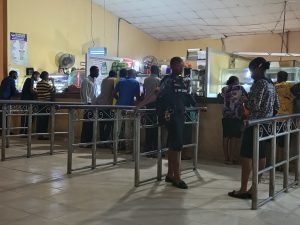
The CBT centre held candidates in a holding area before assigning them to a terminal. The terminal carried the candidate’s photo from registration, and biometric verification by fingerprint was the last check before the exam interface opened.
Printing your JAMB exam slip
JAMB opened the exam slip printing window about two weeks before the candidate’s assigned exam date. You log into your JAMB profile at jamb.gov.ng with the email and password you used during registration, click “Print Examination Slip”, and download the PDF.
The slip carries your name, registration number, centre address, date of exam, reporting time, and a barcode used at the centre. Print at least two copies; one for entry at the gate and one as backup.
Some candidates ran into a quirk: their slip carried a centre allocation different from where they registered. JAMB allocates exam centres based on capacity and proximity, not by where you sat at the CBT centre during registration.
If your allocated centre is far from your home, plan transport at least 24 hours before the exam. Sleep at the centre area the night before if it is more than an hour away; many candidates have missed their slot by getting stuck in traffic on the morning.
If the slip shows a wrong name spelling or wrong subject combination, do not edit it; raise the issue with the nearest JAMB state office before exam day. Trying to “correct” the slip yourself voids the record.
How the JAMB calendar usually moves
The annual JAMB calendar has been steady for the last six cycles. Registration opens in January, closes in late February or early March. The mock exam (optional, free for those who opted in) runs in mid-March. The main UTME runs across the final week of April and the first two weeks of May.
Results start releasing within 24 to 48 hours of a candidate sitting, and most candidates have their result within a week of sitting. The Change of Course window typically opens in May and runs through to the JAMB Policy Meeting in June or July, when the year’s admission framework is finalised.
Schools open their Post-UTME registration windows in June or July, with the screening itself sat in July or August. CAPS uploads admission offers from August through to December, sometimes January of the following year.
If you are mapping a study or family-budget plan around JAMB, use this calendar as the spine and adjust by a week or two for specific announcements.
What to do if you missed your exam date
Missing your JAMB exam date is treated as an absentee record; you score zero for that subject paper and JAMB does not automatically reschedule. The official process is to write to the nearest JAMB state office with documentary proof (hospital admission letter, police report for an emergency, or a school-issued letter for a centre logistics failure).
JAMB reviews each case on its own merit. The board sometimes offers a reschedule within the existing UTME window if the cause is genuine, and sometimes points candidates to the next cycle.
A more common scenario is technical issues at the centre, where the terminal froze or the network dropped during the exam. JAMB tracks this through the centre’s monitoring system, and a re-sit at a different centre or different date within the same window is sometimes granted.
If your centre was responsible for the failure, do not leave without filing an incident form with the centre supervisor and the JAMB monitor on the ground.
Conclusion
The candidates who stay calm on exam day are the ones who knew exactly what to expect well in advance.
Note your date, print your slip early, plan your journey to the centre, and you remove the avoidable stress from JAMB day.
Frequently asked questions
How early should I arrive at the exam centre?
JAMB asks candidates to report at least 30 to 45 minutes before the slot’s start time. Reporting earlier than that is better, especially for the morning slot, because biometric verification can be slow during peak. If you are travelling from outside the centre’s city, plan to arrive at the centre area the night before; missing the slot by being late means losing the entire cycle. Centres lock their gates strictly once the slot has started.
What time was each slot in 2026?
The morning slot started around 7:00 a.m., with reporting from 6:30 a.m. The midday slot started around 11:00 a.m., with reporting from 10:30 a.m. The afternoon slot started around 3:00 p.m., with reporting from 2:30 p.m. Your specific reporting time was printed on your exam slip and was the binding figure regardless of any forwarded message you saw. Confirm on your slip the night before to avoid confusion.
Could I change my exam date in 2026?
JAMB did not allow general date changes in 2026. The date and slot allocation was made by JAMB based on centre capacity, and candidates were expected to take the assigned date. Genuine cases (medical emergencies, centre-side failures) could be raised at the JAMB state office, and a small number of reschedules were granted within the existing window. The “I want a different date because I want more time to study” request was not entertained.
Did JAMB use the same centres for registration and exam in 2026?
Not always. Many candidates registered at one accredited CBT centre but were allocated a different centre for the exam itself. The reason is capacity balancing: a popular registration centre that handled 5,000 registrations may only have 200 terminals, so candidates spill over to other accredited centres for the exam. Check your slip for the centre address; do not assume the registration centre is your exam centre. If you are unsure of the location, visit it the day before the exam.
When did the 2026 results actually arrive?
JAMB started releasing results from late April 2026, within 24 to 72 hours of a candidate sitting. By mid-May 2026, the vast majority of candidates had their result. A small share saw their result held back for verification, usually for centre-side issues or a flagged response pattern. Held-back results were released in batches over the following weeks once verification was complete.
What if I am preparing for the next JAMB cycle?
Plan around the calendar above and watch jamb.gov.ng from November onwards for the official dates. Register early; CBT centres get busy in the last week of registration. Sit the mock if it is offered, because the mock teaches you the CBT interface and the timing pressure. Print your exam slip the moment the window opens, not the day before the exam, because the printing portal slows under load.
Before you act on this guide
JAMB registration windows, fees, and exam dates are announced each cycle and are revised from time to time. Confirm the current dates and charges on the official JAMB portal before you register or pay.
Lagos-based education writer covering JAMB, WAEC and NECO, and tertiary admissions across Nigeria. Chinedu tracks cut-off marks, admission lists, and school portal updates so students and parents do not have to.